English

0 item(s)
View cart
You have no items in your shopping cart.
When your car's AC starts blowing warm air, low refrigerant is a common cause, but not the only one. A failed compressor clutch, a bad fan, a blown fuse, or a clogged cabin filter can feel the same from the driver's seat. Before you learn how to recharge car AC with R134a, confirm that your car actually uses R134a and find its specified charge weight.
This guide from Royal Refrigerants explains how the system works, the tools involved, each step of a proper recharge, and when a professional is the better call.
Yes, in many cases. US rules let DIY owners buy small cans of R134a refrigerant (2 lb or less) with a self-sealing valve. But a can of refrigerant only fixes one problem: a slightly low charge in a system that is otherwise healthy.
Most cars and light trucks built from the 1994 model year through the mid-2010s use R134a. Many newer vehicles use R1234yf instead, and most new cars sold in the US today do. Check the label under the hood, usually on the radiator support or hood underside. It lists the refrigerant type, the charge amount, and the oil type. Our guide on how to identify R134a refrigerant shows what to look for.
A DIY top-off can work when the AC still cools somewhat, the compressor engages, and the system has lost refrigerant slowly over a few years. It is not a fix for a fast leak, a completely empty system, or an unknown problem.
The AC loses its cooling again within weeks
You see damaged hoses, oily fittings, or a leaking condenser
The compressor makes noise or does not engage
The system is empty or has been opened for repair
You are unsure which refrigerant the car uses or how much it holds
Refrigerant moves in a loop, picking up heat inside the car and dumping it outside.
AC compressor: Driven by the engine belt, it pumps and compresses refrigerant vapor, raising its pressure and temperature.
Condenser: Mounted in front of the radiator, it cools the hot vapor until it turns into liquid.
Expansion valve or orifice tube: It drops the pressure of the liquid as it enters the evaporator.
Evaporator: Behind the dash, the cold refrigerant boils and absorbs heat from cabin air blown across it.
|
Tool |
What it does |
Who uses it |
|
R134a recharge kit |
Can of refrigerant plus a hose and gauge |
DIY |
|
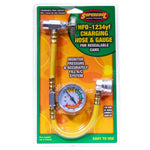
R134a recharge hose with gauge |
Connects to the low-side port and reads low-side pressure |
DIY |
|
Manifold gauge set |
Reads both high and low side pressure |
Pro and advanced DIY |
|
Vacuum pump |
Removes air and moisture after a repair |
Pro |
|
Refrigerant scale |
Measures charge by weight |
Pro and advanced DIY |
|
Leak detector or UV dye kit |
Finds leaks |
Pro and DIY |
|
Thermometer |
Checks vent temperature |
Everyone |
For DIY top-offs, a case of R134a 12 oz cans goes further than single retail cans. Shops that service many cars usually buy a 30 lb R134a cylinder and charge with a scale or service machine.
A single-gauge recharge hose only shows low-side pressure. It cannot tell you the exact amount in the system.
Wear protective gear: Safety glasses and gloves. Liquid refrigerant can freeze skin and eyes on contact.
Identify the correct refrigerant: Never put R134a in an R1234yf system, or mix it with any other refrigerant.
Respect high pressure: Never connect a can to the high-side port. High-side pressure can force refrigerant back into the can.
Avoid venting: Releasing refrigerant on purpose is illegal under the Clean Air Act. Refrigerant that must come out has to be recovered with proper equipment.
The steps below show how a proper recharge works. Simple top-offs use only the first few steps, while a full service uses all of them.
Confirm the label says R-134a (or HFC-134a). Write down the refrigerant capacity, often listed in ounces or grams, and the oil type. If the label says R-1234yf, stop here, because R134a products will not fit and must not be used.
The low-side port sits on the larger aluminum line between the evaporator and the compressor, usually with a cap marked "L." The high-side port is on the smaller line between the condenser and the expansion device, often capped "H." R134a uses different-size quick-connect fittings, so a DIY recharge hose only fits the low side. Never force a fitting.
Look at hoses, fittings, and the condenser for oily stains, which usually mark a leak. Start the engine, set the AC to max, and check that the compressor clutch engages. Make sure the condenser fan runs and the condenser fins are not blocked by debris.
If the AC needs refrigerant, it has a leak somewhere, even if it is slow. UV dye with a blacklight or an electronic leak detector helps you find it. Adding refrigerant without fixing a fast leak only buys a few days or weeks of cooling. Our guide to professional refrigerant leak detection explains the main methods.
If the system is empty, has been opened for repair, or might hold the wrong refrigerant, a certified technician should recover what is left and pull a deep vacuum. Evacuation removes air and moisture that cause poor cooling, high pressure, and internal corrosion. DIY cans cannot do this step.
The label's capacity is the correct amount. Professionals weigh it in with a scale or service machine. If you are topping off with a can, add refrigerant in short bursts into the low-side port with the engine running and AC on max, and stop well before the gauge's upper range. Do not keep adding until a generic "green zone" is reached, since that range does not account for your car or the weather.
With the engine at about 1,500 rpm, doors open, and AC on max, measure the center vent temperature. Many healthy systems produce vent air in the 40s°F on a warm day, but the service manual sets the real target. Watch whether the compressor cycles normally. If cooling is still weak, stop adding refrigerant and diagnose further.

Check the under-hood refrigerant label first, then the owner's manual or manufacturer service information. Capacity varies a lot by vehicle, and vehicles with rear AC hold more.
There is no universal amount, and pressure readings alone cannot tell you how much refrigerant is inside. Too little causes poor cooling. Too much raises head pressure, strains the compressor, and often cools worse. Weighing the charge is the only accurate method, which is why it avoids many common refrigerant charging mistakes.
The low-side gauge shows the pressure where refrigerant boils in the evaporator. Very low readings can point to a low charge or a restriction. High readings can point to an overcharge or a weak compressor.
The high-side gauge, on a manifold set, shows how well the condenser rejects heat. High readings often mean poor airflow, a bad fan, overcharge, or air in the system.
Both readings rise as outdoor temperature and humidity climb. That is why no single pressure number fits every car on every day. Compare readings with the vehicle's service chart and the R134a pressure temperature chart.
Overcharging: Extra refrigerant raises pressure and lowers cooling. It can also damage the compressor.
Using the wrong refrigerant: R134a and R1234yf systems are not interchangeable. Mixing them contaminates the system and the shop's recovery equipment.
Ignoring leaks: Recharging every few weeks wastes money and releases refrigerant. Fix the leak.
Relying on one gauge: A low-side reading alone cannot show the correct charge or the health of the high side.
Low refrigerant: Usually from a leak at a hose, O-ring, condenser, or compressor seal.
Compressor problems: A worn clutch, low clutch voltage, or internal failure stops refrigerant from moving.
Condenser fan problems: Without airflow, the condenser cannot shed heat, so cooling drops at idle and in traffic.
Electrical faults: A blown fuse, failed relay, or bad pressure switch can keep the compressor off.
Other causes: A clogged cabin air filter, a blend door stuck on heat, or a blocked orifice tube or expansion valve.
|
Comparison |
R134a |
R1234yf |
|
Refrigerant type |
HFC |
HFO |
|
Common use |
Most cars from 1994 to the mid-2010s |
Most new cars sold in the US today |
|
GWP (AR4, 100-year) |
1,430 |
Less than 1 |
|
Safety class |
A1 |
A2L (mildly flammable) |
|
Service fittings |
R134a quick-connects |
Different R1234yf quick-connects |
|
Service equipment |
R134a tools and machines |
Dedicated R1234yf tools, such as a MAHLE ACX2280 R1234yf service machine |
The two refrigerants and their tools are not interchangeable. If your label shows R1234yf, use R1234yf refrigerant 12 oz cans with a matching 1234yf charging hose with gauge. Our guide on whether you can use R134a instead of R1234yf explains why not.
Confirm the car uses R134a, check for leaks, connect a recharge hose to the low-side port, and add refrigerant in short bursts with the AC on max. A full service recovers, evacuates, and charges by weight.
"Freon" is a brand name. Most cars use R134a or R1234yf, so check the under-hood label and follow the steps above for the correct gas.
For a small top-off on a sealed system, yes. A system that has been opened, repaired, or emptied needs evacuation first.
A top-off takes 15 to 30 minutes. A full service with leak repair, evacuation, and charging can take a few hours.
For a slow, minor loss, often yes. They cannot fix leaks, failed parts, or an empty system.
Not usefully. A compressor that does not engage may have an electrical fault, a failed clutch, or a charge too low to trip the pressure switch. Diagnose first.
Pressure climbs, cooling drops, and the compressor works harder, which can shorten its life.
Slowly weakening cooling and a clutch that cycles on and off quickly are common signs, but only proper testing confirms it.
It depends on the vehicle, outdoor temperature, and humidity. Use the vehicle's service chart.
Some cans include sealer, but it is not a real repair, and many shops will not connect equipment to a system with sealer in it. Fixing the leaking part is the lasting solution.
For refrigerant pricing, see our guide on how much Freon for a car costs. When you are ready to recharge, Royal Refrigerants stocks R134a in cans for DIY owners and cylinders for shops.
 Ranking Serve